6 days ago
Showing posts with label Technology. Show all posts
Monday, April 7, 2014
Tempus Fugit
I have to apologize for missing yesterday's blog entry, but the weather was absolutely beautiful- about 60 degrees , no wind, lots of sun and no humidity. I haven't seen a day like that in 2 years it seems like. So I went outside and did lots of stuff, and then last night I celebrated my son's 21st birthday. I took a day off; so sue me.
But I already had a blog planned out. I just didn't write it. It went something like this:
I have a tall case clock in my living room. I have to wind it by resetting the weights, and usually I need to reset the time. I have been trying to get it regulated by adjusting the pendulum. About the time I seem to get it regulated the weather changes and I have to start all over again. That's the nature of a mechanical beast; temperature and humidity cause things to swell or shrink, and even if a gear only swells a small fraction of an inch, when you have a hundred gears the amount of change adds up; it is a cumulative effect.
This clock also chimes the quarter hour- 4 chimes; the half hour- 8 chimes; the three-quarter hour- 12 chimes, and on the hour 16 chimes plus it bongs out the hour. I'm not bragging about my clock; I'm explaining how we used to tell time. Back in the day a house would have one clock in it, and you would know the time without looking, as long as you remembered the last chime. Everyday the town clock would strike at noon (at least), and you would reset your clock to match the town clock, so everybody in the village would be on the same time.
Time was a flexible thing; Church on Sunday was just about the only thing you had a specific time for. otherwise, a few minutes one way or the other was not just common, it was almost expected. Time keeping was not an exact science.
Now think about today. What room doesn't have at least one clock? A clock that is accurate to within a minute a decade? How many rooms have three or more? How clocks do you carry with you? One on your wrist, and one on each phone. And then one on your computer. It is impossible to escape time. The modern world doesn't have the same flexibility on time older ones did. There is no being 5 minutes late for a meeting, or for work. Or Heaven forbid, lunch.
We are not just creatures of time, but slaves to it. We have marks to hit many times a day, and those marks are solid. Not all are work related; TV Shows, movies at the theater; basketball games and tee times are all hard points we need to hit or miss an opportunity. Our day is broken in to 30 minute, 60 minute or 120 minute blocks; each segment ending just as fast as the next one begins. Some segments are marked by alarms- like the end of the night, others by internal markers; knowing that if we aren't in the shower by 7:00 we will not make work by 8:00.
And we also know that there is nothing we can do about it. Even vacations are ruled by the clock, to a certain extent. Flights; checkout times; dinner reservations.
When was the last time you were able to spend two days without a clock?
Probably like me; the summer between 5th and 6th grades.
Labels:
History,
Random Thoughts,
Technology
Wednesday, March 12, 2014
That Was Then
A few weeks ago my Aunt sent me an email that talked about how things were in 1910. All kinds of information, which I assume is correct. It sounds correct anyway.
Things like: The Population of Las Vegas Nevada was only 30!
Yeah; I'll buy that. Los Angeles wasn't much bigger.
Or how about: There were about 230 reported murders in the ENTIRE U.S.A. ! Yeah; I'll buy that one too.
But this one causes me to doubt the veracity of the whole thing: Ninety percent of all Doctors had NO COLLEGE EDUCATION! I can see where they would have not had a medical degree, but NO College? sounds fishy.
How about this one? There were only 8,000 cars and
only 144 miles of paved roads. By 1910 Ford had been producing the Model T for 4 or 5 years, and eventually built 15 million of them; 8,000 sounds awfully low. Especially since there were almost 8,000 manufacturers in 1910. Okay; that is a bit of an exaggeration, but not by much.
The point of the email is how much things have changed in a hundred years, and questions how much they will change in the next hundred.
I have a different take (I'll bet your surprised!). Look at how much things have remained the same, and what will still be the same in a hundred years?
We're still using the same clock and calendar; noon on March 13th, 1914 is still noon on March 13th, 2014. I can see noon on March 13th, 2114 as being the same as well.
We had the telephone then, and do now. The concept is still the same, even though the actuality is different. We still use a number to connect to whoever we want to talk to. We used to connect to a location, now we connect to an individual. I don;t see that changing in another 100 years, except that we each may be assigned a number at birth that will connect us for life, and be used for all purposes, from phones to credit cards to government IDs. I didn't say I want or like the prospect of it happening, but I can see it happening.
We have only added 5 states in the last hundred years; I can see not adding anymore in the next hundred, unless something changes that makes joining the US more advantageous than not doing so.
We had electric lights in 1914, and still have them. I can see them in 2114 as well. The source of electricity may be different, and the bulb may be something we don't have now, but we will still flip a switch to have light.
Recorded music and movies were around back then, and still around now. There may be some differences in how we record and film, but we still record and film. And will in a hundred years.
History is interesting, and we can always compare both positively and negatively in any two eras. What we view as negative or positive is always in the eye of the beholder.
So while I may view the fact that the 1911 Colt's design has lasted 100 years as a positive thing, others may decry the fact that we still have need of one.
Labels:
Random Thoughts,
Technology,
Technology Cars
Thursday, May 2, 2013
Where I Have Never Gone Before
Ever since I got Netflix a few years ago I have been slowly working through the Original Star Trek TV series. Right now I think I have 2 episodes left. It is easy to see why the show was so popular in certain circles.
It is also easy to see why there was no season 4.
First; the popularity. I yet to find an episode without a half naked woman. This has to be the sexiest show on TV in 1967. Every show also had at least one fight sequence, usually hand to hand, but occasionally they would just 'blast away' at each other. And, in the era when we are just starting to send men into space for a few days trip to a celestial body we could see nightly, The Enterprise was traveling at the speed of light to places we could not.
Despite some classic episodes, the writing is very uneven. Somehow the story lines in some cases either haven't aged well or were junk 45 years ago. In one of the last episodes appear the Space Hippies. Was there some well-received social message in 1968? Maybe. But if there was it was long gone by 2013.
And then there was the physics.
Why is it that most alien planets seem to be able to violate at least one law of physics? Or maybe in the future we will be able to repeal some of Newton's Laws? Except that it always seems to the lack of a law of physics that enables the aliens to be a step ahead of our intrepid crew.
Either that, or the super computer built 200 years ago that has been powering the planet (without maintenance, to the point where the inhabitants don't even know of the computer's existence) that gives them their power.
Each episode also followed the 1960's formula; balance the drama with a bit of humor, throw in a musical number or two occasionally, and a fight scene every week whether we need one or not.
In Season Three they added the philosophical musing. I don't know if they were trying to go in a different direction or felt secure enough in their audience to become preachy; and these musings are preachy.
I haven't become a pure 'Trekkie'. I can't tell you the author of every episode or go into the reason why Spock pushed the wrong button on his science console in episode 6 of season 2.
But I can tell you that Spock and Kirk drove a 1928 Packard V-12 in the episode where they run into a planet full of aliens who acted like it was 1930's Chicago.
But that's cause I'm a car guy.
Still, over all the series has held up well 45 years later. The dialogue is sometimes a little stilted, and you can tell they used the very best cardboard for some of the sets. AND WHY DOES EVERY DAMN THING ON THE BRIDGE HAVE TO CONSIST SOLELY OF FLASHING LIGHTS!?!?!?!?!?! That, and the noise the redlight below the view screen seemed to make I would been stark raving nuts before the end of season three.
So maybe that's why there was no season four....
Wednesday, January 9, 2013
Say Cheese!
I did a post the other day on the changes in the last hundred years on the way music has changed in our lives.
At the same time I was thinking about the ways that photography has changed as well.
Photography was initially developed almost 200 years ago. The process of using light to cause a chemical reaction and create an image was a startling revelation. History could now be documented in real time. As long as history would stand still and had plenty of light thrown on it.
50 years later Matthew Brady would do just that, making hundreds of images of the carnage on Civil War battlefields.
The process has changed sometimes; the chemicals used or the base material. Tintypes are just that- an image created chemically on a metal plate, and glass plate negatives were just a chemical wash on a glass plate, subject to the hazards as any piece of glass is. The modern negative film was the development that put a camera in the hands of the common man. George Eastman was the Henry Ford of photography; Ford put the common man on the road with his Model-T, and Eastman allowed him to photograph the trip.
The images were still; very still. We are so used to micro-second exposure times, but images in the old days took minutes to expose, which is why most old pictures are stiffly posed portraits.
The Kodak Brownie had those same issues; slow film speeds, no adjustable aperture, no flash. Groups didn't gather on the front porch for their health; they needed the light to make sure the picture turned out.
And then once the roll was full, the whole camera was sent off to Kodak, returned a few weeks later with your pictures and a fresh roll of film inside, all set for 8 more shots. And that's when you found out that Aunt Martha had moved during the Easter family portrait.
Cameras became more complex, and those cameras eventually made their way into the hands of the amateurs. Although amateur in this case just meant took pictures for fun, not profit. Film speed had to be set, f-stop, depth of field and focus all had to be right, and heaven help you with color film!
And you had to wait a week to find out if that once-in-a-lifetime shot had turned out.
Unless you did your own developing; tubs of caustic chemicals and very specific timings. Old chemicals, to long or too short in one bath or the other and your negatives or your pictures were ruined.
And then came the Kodak Instamatic with it's Flash Cubes. Point and shoot, inside or out, a (fairly) perfect shot every time. But film and developing cost money; about 6 bucks all told for 24 shots. And you had to wait to see the picture.
Unless you had a Polaroid. Take the shot, catch the picture as it spit out the bottom of the camera, keep it warm in your armpit for a minute and voila! Pictures! Want two copies? Take two pictures. At about 50 cents each.
Kodak and Polaroid were getting quietly rich.
Then came the image sensor; developed by an employee at Kodak, of all places, in 1975. It took 20 years, but once the sensors became cheap everybody wanted one. No film; no developing; no wait pictures. Snap one? Hell no; snap 50. Things not worthy of documenting 10 years ago now became fodder for a battery of images.
And just when the digital cameras thought they had a monopoly on the market, BAM! The iPhone, and now every phone has become a pocket photo studio.
My grandfather took pictures of me and his other grandkids with an Argus 35mm; fully manual, it took some great pictures, once you knew how to operate it, a skill I had just about mastered when I got my first point and shoot digital 10 years ago.
Now my son sees his boys in a cute pose, pulls out his phone, snaps off a pic or two, and texts them to me on my phone.
I think his Great-grandpa would be proud.
Labels:
History,
iPhone,
Photos,
Random Thoughts,
Technology
Monday, January 7, 2013
Music Makes The World Go Around
Have you ever given much thought to music?
Today we don't have to; drag out the iPod; pull up a song. Don't like it? Dump it and pull up another. But that technology, through the iPod, is just over 10 years old. MP3? About 20.
Before that we had Tapes; Cassette; Reel to Reel and 8-Track. And of course before that albums and 45s. Or 78s. Or even further back, wax cylinders.
Before that? All music was live.
We have become accustomed to music being a constant soundtrack to our lives; our MP3 players; the radio or CD in the car; muzak piped in the stores and elevators; even coming through our TVs through the miracle of cable. Pandora coming through your flippin' cell phone!
Less than 100 years ago it wasn't so easy. You want a tune? Whistle it. Or Hum it. Or know somebody who who can play it on some instrument or the other. Sure; you could buy a Victrola in 1913; for $75.00. When the average year's salary was $1300. Two weeks pay; give or take a couple of hours. Plus records at a buck or so each. That one song would lose it's novelty real quick.
Dances in the rural areas were a godsend; a reason to get together and music to boot, provided all of the members of the band could get together.
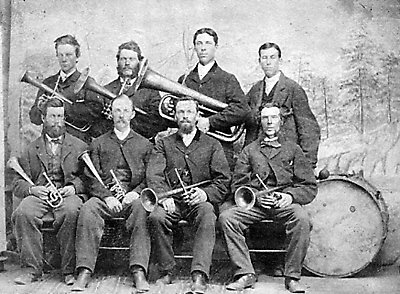
You think a barbershop quartet sounds goofy? Compare it to no music at all. Sounds pretty good now, don't it? Ever wonder why you always see Uncle Ed with his guitar in old family photos? Because he brought the music.
Stop and think for a minute about how dependent we are on electrons for music today, and how few folks play an instrument. Every high school had at least one band back in the day. The official one that played at football games, and there were always 4 or 5 guys banging around in somebody's garage or basement, hoping to play the school dance some Saturday night.
There was also a community to be had when a band got together and a dance was in the offing.
Something that's hard to achieve with a pair of earbuds.
Labels:
Antique Things,
History,
Music,
Random Thoughts,
Technology
Sunday, January 6, 2013
Sometimes a Book is Just a Book
I recently read Pillars of the Earth by Ken Follet. I
am still trying to make my mind up about the novel in some respects.
Parts were a fascinating read; others parts I found less
interesting, particularly the parts that seemed cribbed from a Penthouse Forum
Magazine. Every chapter seemed to have a part that should have begun “I really
never thought it would happen to me, but…”
The worst part was the end. It
literally felt like the author ran out of enthusiasm for the book and just
wrapped it up somehow. Through a thousand pages a given character would act a certain
way, with certain motivations. In the last 80 pages all of that went out the window.
Am I glad I read it? Yes. But I won’t bother with the sequel
and I won’t bother to read it again. How’s that for a ringing endorsement?
As briefly as the plot of a 1,087 page novel can be
described; a small, fictional medieval English Monastery and its village build
a cathedral. The book chronicles the arrival of the master-builder to the site
and the various political and financial maneuverings that both enable and
stymie the construction. That also includes the personal lives of the various characters;
the Prior of the Monastery, Prior Phillip; the builder, Tom; his family-children,
step-child and wives; the local Bishop and the local Earl.
This is where I found my first fault; only one or two of the
characters were well rounded, even the essential ones. If they were evil; they
were never nice to anyone. If they were good, they never had a bad moment.
Until the last chapter.
The second fault was the lack of detail on the construction
of the Cathedral. For a book about the building, you would think a few of the 1087
pages could be spared for a few details on the actual construction or maybe a
description of the various trades involved. But then the author would have had to
drop one of the forty or fifty sex scenes that seemed to plague the story. I
was beginning to think someone had actually slipped me a copy of 50 Shades
of Grey. Based on this book every Cathedral in Europe physically went up
without a hitch.
Well, until they fell down. Which, of course, this one did.
The primary crux of the story was the change between round and pointed arches;
a discussion that took place with minimal interruption of the characters lives
and even less explanation of why this was such a sea change in public building.
They did discuss how the pointed arch allowed for taller churches with more
windows, but more history of development between the round and pointed arch
would have been apropos, especially given the pivotal place in the story given
to the pointed arch.
Bear in mind, in most communities the Church was THE public
building. There were no public halls or municipal buildings like town halls. The
Church was the town hall; it was the center of the community and the gathering
place for every purpose.
Pillars does reflect that, and in some ways is a
fascinating look into Medieval England, in the years immediately following the Norman
Invasion and during the period of Anarchy after Henry I death. The history
seems to be correct, albeit with our fictional characters thrown into the mix.
And one of the fictional characters being thrown into the mix suffers a non-historical
fate. But, since he really wasn’t a part of the history, and his fate is almost
required by the story, so, no harm, no foul. At least in this case.
But there were a lot of other fouls; illiterate builders use
multi-syllabic words; the language itself is not even remotely like Norman English
and the characters seem to be able to speak both native English- akin to
German- as well as Norman English- very French-like- with equal ease and
without fault. There also seemed to be an acceptance of quite a few cultural
items without comment, almost as if we should be as familiar with the methods
of Medieval Dress and Buildings as we are with modern ones.
These can be written off as poetic license; liberties taken
to insure a smooth flow and readability of the story. And I would be willing to
agree; if elements of the story itself didn’t constantly remind me of a
Harlequin dime romance.
Let’s take the character of Waleran Bigod. When we first
meet him he is an archdeacon to the Bishop of Kingsbridge, the fictional
location of the Cathedral. His first act in the book is to scheme with the hero
of our story, Prior Phillip, maneuvering Phillip into agreeing to support Bigod
to replace the current Bishop. Later it becomes evident that the Bishop was
already dead, a fact Bigod was hiding from the world. This is just the
beginning. Bigod is constantly scheming, lying and dealing, not only as an
arch-deacon, but as a Bishop as well. His scheming never lets up, and includes
the ordering of the murder of members of his diocese, with absolution granted
prior to the act itself.
And then in the last few pages he repents and becomes,
almost literally, a kind, saintly old man. Which in itself is not a problem;
entire books are based on the reasons behind a character’s motivations for
changing himself. But here the motivation is lacking. Maybe it’s there, and I
just missed it. But the change is similar to Saul’s conversion on the road to Damascus,
without the intervention of the Lord’s lightning.
Set in an era when The Church ran everything, and being
ex-communicated was almost a death sentence, only Prior Phillip seems to be
truly devout. Monks in the Monastery do their best to avoid devotionals or anything
relating to their religious duties and most of the main characters, most of
them deeply involved with building a Cathedral, the highest concrete form of
worship, seem agnostic at best, and atheist at worst.
As I said early on; it was a fascinating read in parts, and
I am glad I read it.
I am also equally glad I didn’t buy it.
‘Nuff said.
Labels:
Architecture,
Books,
History; Great Movies,
Religion,
Technology
Wednesday, December 5, 2012
Schedule? We Don't Need No Stinkin' Schedule
Last night we turned on NCIS- which is just about the only show I watch on broadcast TV- and I wasn't on. Rudolph the Red Nosed Reindeer was instead.
And we turned it off.
A classic Christmas program, one I have enjoyed almost my entire life. And we turned it off. Why?
Because the shows that we once waited all year to see; the shows that defined and delineated the Christmas Season are all sitting on the library shelf; viewable any time, in High Def and without commercials.
Why sit through a program on someone else's schedule when you can view on your own?
In some respects, that is the most modern of TV metaphors, and the reason both broadcast TV and even cable TV is dying.
Yes; you can DVR a show and watch it later. And when you do, do you watch the commercials or zip through them? But cable is $80 a month; Netflix is $8. Save a few bucks and stop paying for channels you never watch; cut the cable. It's happening all over the country.
You can even watch most shows on your computer, at your convenience. No more rushing to meet that 9:00 PM on Thursday time slot. Kick back on Friday when the dishes are done at 6:39 and fire up the show you want to see.
How long until the cable channels get wise and stop distributing shows over cable, but have their channel available internet only? Would it be a successful business model for the History Channel to be available over the Wii? Shows that once were scheduled for Sunday night at 9:00 will now be available for viewing anytime after 9:00 on Sunday.
No more surfing through 90 channels of garbage to see what's on. 50 million homes at $1 a month is some pretty long green. Plus an ad or two at the beginning of the show.
I would go into more detail, but its 9:41PM; I think I'll go fire up something on the Wii; I feel like watching a Mythbusters episode.
Labels:
Technology,
Television,
The Economy
Sunday, November 18, 2012
Way Too Much Time On His Hands
Just when you think you've seen it all, you see something that makes you wonder.
Take a look at this machine. First; who figured they needed this: second, who figured out HOW to build it, and Third; who ever built it did one hell of a job.
But they all had way too much time on their hands.
I found the video put perusing a site I usually use to figure out home repairs; There; I Fixed It.
Lots of good fun over there for a Redneck.
Labels:
Redneck Fun,
Rest and Relaxation,
Technology
Sunday, October 14, 2012
Remodel, Finale
I should really say Finale; we still have a few small things to do, but yesterday was the end of the trim work. We hung the crown molding.
As a devoted fan of This Old House I have watched crown molding go up many times. I knew the tricks. or so I thought. My son was willing to try it on his own, until after he had cut and hung the first piece. Then he called me. I figured we would start about 10 and be done about 12. Its a small bathroom; just 5 feet by 8 feet; shouldn't take long.
Well; except we ran into a problem or two.
Crown molding didn't seem that difficult to hang, and the last few pieces weren't. But that first piece; WOW.
Maybe a few explanations are in order. Most molding on walls is hung flat; like baseboards and chair rail. Where two pieces meet a simple miter joint is used. I say simple, but they are not simple to cut, sometimes. But a simple miter basically divides the 90 degree angle into two 45 degree angles, one 45 degree cut on each piece to be joined, and when put together they fill the 90 degree corner.
A miter will work well on either an inside corner or and outside corner (an inside corner is like one in the corner of a room; an outside corner is one that protrudes into a room). But there is a second method of creating an inside corner called a cope joint. A cope joint is where one piece of molding is left at a 90 degree angle and the piece that joins it is cut on the end to match the profile of the molding it is meeting. It sounds hard, but in practice isn't, because of a few tricks.
Coping crown molding is very similar, but completely different. I worked at least an hour on the first cope cut; cutting, test fitting, cutting again; test fitting again. Cutting AGAIN, and test fitting AGAIN. I could never get the joint to match up. Then I tried matching my cope cut up with a piece of molding not mounted on the wall. It matched perfectly. Then I moved my piece of molding around on the wall until I had a perfect match. I the realized the molding my son had hung wasn't at the right angle.
Crown isn't hung flat; it forms a 45 degree angle around the 90 degree angle of the wall and ceiling. The piece I was working off of wasn't at 45 degrees. By now I had a perfect left miter and a perfect right miter, so we pulled down the piece that was up and used our cut pieces to align it perfectly.
From then on it was smooth sailing. The first cut took over an hour; the last one took about 5 minutes. Because we put crown in the shower stall as well as the rest of the room we wound up with 6 cope joints and 2 outside miters. From first cut to final nail was about 4 and a half hours; twice what I originally thought. But from second piece of molding to final piece of molding was about an hour and a half. So I guess I have a 3 hour learning curve.
It was also made easier by my son having hung the first piece. If I would have hung it it would have taken a couple extra hours to convince me I had done the first one wrong.
All the while we worked my son kept telling me he could never be a carpenter; he didn't have the patience. Well; I didn't either at his age.
Sunday, September 16, 2012
Define Self-sufficiency
I found this through Instapundit the other day; a very good read. I guess I liked it because we have a man of superior education who agrees with me.
The modern world is almost completely cut off from self-sufficiency. Some of us like to think we are self-sufficient, but in reality we are as dependent on others for survival as the biggest welfare queen.
For example; say your water heater goes out. You call a plumber, he installs a new one, and you pay the bill. Not very self-sufficient.
Now lets say instead of calling the plumber, you install one yourself. That's self-sufficient you say?
Maybe. Did you make the water heater, or did you drive on government roads in a car you bought to a big box store where you bought a new water heater that somebody else made and somebody else shipped in a truck made by somebody else on the same government roads you are about to haul your new water heater home on?
The 19th century, and earlier, idea of being self-sufficient is completely different than today's version. Very few people lived in towns, because town did not allow enough ground to raise you own food- both flora and fauna- and to hunt from the wild what you didn't or couldn't grow. Like trees for housing and fuel.
a 19th Century man knew where his bacon and eggs came from; he had raised the hogs and chickens, slaughter the hog and cured the bacon in a smokehouse he built from the stones he cleared from his fields over a fire he fed with wood he had cut from his own land.
Or he lived in town, and created something he was able to sell that would allow him to purchase what he needed from those who had excess. And even in town he would have had a few chickens.
There is a family farm near me that has been in the same family for generations. Around a hundred acres, that farm is still producing, just like it did in the 19th Century. But the same farm that once supported a family in style solely from the work they did on the farm, now does not. The farm still produces the same, but our modern life style requires us to be dependent, and not self-sufficient.
A 19th Century farm will not produce a new water heater, nor the electricity to run it, nor will it produce enough excess to create the cash needed for these items, or the hundreds of others we now 'need' for survival.
Go back just 40-50 years and think about the lifestyle we all lived. One TV; black and white usually, but maybe color. And only 3 channels; maybe 5 if you have a UHF tuner. One phone; black, with a dial and tied to the wall with a fat cord. I could go on; as could you. In a little over one generation, look at what God hath wrought.
And every change has made us less self-sufficient and more dependent.
Some of us know how dependent we are, and some don't. I like to believe that those of us who know we are dependent are the conservatives. We know the cost and value of labor, and are willing to share with those incapable of laboring.
And then there are those who don't know the cost or value of labor, and are willing to share yours with anybody else.
I think we need more people in this country who know that bacon doesn't come from Kroger's, but comes from the hard labor of a lot of folks; just like they did in the 19th Century.
Monday, September 10, 2012
Out and About on the Internets
I was visiting at The Borderline Sociopathic Blog For Boys when I ran across this post of his, and I just had to share, for several reasons.
First, it is a wooden model. Anybody with access to a couple of trees and chainsaw could make one. Okay, that maybe a simplification, but you know what I mean.
Then there is the way the video explains the entire process, as they add parts to the model to make the next step of the firing process happen. they manage to take a hundred years of weapon development and make it seem like this was all a logical progression.
If you think about what they were trying to do with this video, you have to marvel at the genius behind it.
In the 1940's they had to take men from all walks of life and introduce them to semi and fully automatic weapons. Not just to fire, but to maintain, troubleshoot and depend on, up to the cost of their life.
The pace is a little slow, but then was done 70 years ago; well before the invention of the music video.
Now I've got the bug; somebody may get one of these for Christmas....
I meant the gun, not the video.
Labels:
Guns,
History,
Redneck Fun,
Technology,
Veterans
Wednesday, August 29, 2012
Convention Time Again
Last night was a busy night, and I did not get to see any of the Republican Convention. I am trying to catch up tonight. Did you know the Convention can be live streamed? Instead of being tied to the Cable box or the TV I can go anywhere the WiFi will take me and watch the activities live, and without the commentary of the Lame Stream Media.
Right now I have the Convention booted up on the laptop while I'm blogging on the desktop. Ain't technology a wonderful thing?
Back in the day, when Conventions meant something, and the nominee was in doubt until the votes had been cast on the floor of the convention center, my Dad used to watch both Conventions from gavel to gavel. He was, what would be called today, a recovering Democrat. He was a registered Democrat for years, until he felt the party had swung too far from what he believed, and he became and Independent. Finally, in one election, I forget which one, he finally registered Republican so he could vote in the primary. And then promptly changed back to an Independent. I really think he kept hoping he could morally become a Democrat again.
It never happened.
But every 4 years he would haul the portable TV out to the pack patio and spend 2 weeks watching both parties set their platforms and nominate their candidates. And every four years he would come away disappointed.
And now, the Conventions are more of a commercial for the Party, both Republican and Democrat, than a news event. The vote for the candidate used to be the last thing to happen. The entire week would lead up to the vote, or in close years, votes, for the candidate, leading up to the acceptance speech from the newly minted candidate.
I miss that drama. I miss hearing the states during the roll call vote proclaiming first their individuality, and then their allegiance. "The Commonwealth of Kentucky, home of Fast Horses, Great Bourbon and Smooth Tobacco, casts its 42 votes for the next President of the United States....". It was always exciting; sitting in the dark, the only light coming from the small black and white screen of the portable TV, watching the drama unfold on the floor of the hall, whether from New York, or Miami Beach, Or Kansas City, you could feel the tension and almost smell the smoke from the numerous cigarettes and cigars that flooded the hall.
The vote tallies would climb, first a few votes here, and then a few votes there, with Huntley and Brinkley commenting in the background: "Well Chet, the vote from Minnesota for McGovern in this round was a given, wasn't it?" Then discussing the possibilities of the vote from Missouri going his way or not.
This year the big discussion was which state would put Romney over the top.
And seriously, I don't care which state it was.
I might just take the laptop out on the back porch and watch a bit of the activities, just for old time sakes.
Or not.
It wouldn't be the same without Dad.
Labels:
2010/2012,
Elections,
Found on the Internets,
History,
Reagan,
Technology,
Television
Monday, August 20, 2012
The Tree and The Acorn
I know you've heard the old saw about the acorn not falling far from the tree.
Well, Saturday my second oldest officially became a redneck.
Jeff Foxworthy defines Redneck as 'a glorious lack of sophistication', a definition I agree with. But there is also a individualistic, self-sufficient bent that I think is a requirement in a good Redneck. Here is my son's story.
Apparently Saturday afternoon he wanted to watch a few movies on DVD. But His DVD player wouldn't work. So, unlike your hipster-dofus, who would grab a credit card and his password to Amazon. my son grabbed a screwdriver. And started dismantling his DVD player. After a few screws, he discovers the problem. The drive belt between the motor and the spindle that drives the DVD unit is broke, and laying in the bottom of the player.
End of the day, right? Not by a long shot.
Our intrepid young Redneck does not let a broken part stop him. He goes On the Hunt for a replacement. But where do you find a replacement drive belt for a cheap DVD player on a Saturday afternoon?
Why in the basement of course!
Not that I have a stockpile of old DVD players in the basement; I don't. But what our Redneck Repairman is looking for is flexible piece of rubber, like a rubber band, but a whole lot smaller.
When ever I replace a burnt out headlight bulb, I replace them both, and put the one that still worked on the shelf as a spare. That way, if a blow another bulb I can put in the old one until I can get to the store for a new set.
Well, something even I didn't know is that the rubber ring that the bulb maker uses to seal the bulb into the headlight housing is exactly the same size as the drive belt in cheap DVD players.
A few seconds to slip the seal off of the bulb and Voila! a new drive belt.
The player was reassembled and has been working steadily and well ever since.
For those of us with a special bent, this is a proud moment.
Almost enough to bring a tear to an old man's eye.
Except he had to go and ruin one of my spare headlight bulbs.
Labels:
Movies,
Redneck Fun,
Small Successes,
Technology
Sunday, August 19, 2012
A Fair and Biased Press
I was talking with some friends the other day, and as usual the conversation turned to the upcoming election.
Will we keep the House? Will we win the Senate? Will we dump Obama?
During the conversation I had an off the wall thought.
I will allow the Dems to keep the White House and the Senate and give them House. I just want one thing in return:
A fair and honest Press. I want every TV station and Channel; every newspaper and magazine to honestly report what is happening in Washington and every state capital. If that happens for the next 4 years, Then I'll happily vote for a Democrat.
I figure the odds of that happening are about the same as me hitting the Powerball and the Mega Millions in the same week. Twice.
You know what bothers me? We have had a Constitutionally had a free press in this country since 1787. And we have had a biased press since 1787.
The thing was, in the old days you knew the Newspaper was biased, and you read it because of its biases. Today it's CNN & MSNBC on the one side, and Fox News on the other. Back in the day, in Cincinnati at least, the Democrats read the Post and Times Star; Republicans read the Enquirer. You knew how the news would be reported, and expected that bias. The newspapers prided themselves on that bias.
I have access to a unique collection of old Cincinnati newspapers. One day in 1915 a carpenter hung a full length mirror on a bathroom door, and stuffed some of yesterday's newspapers behind it to keep it from rattling.
A couple of years ago they were pulled out. What the carpenter had used were almost complete editions of the Cincinnati Enquirer; the Post and the Times Star. The big news the day, at least internationally, was a German victory in a battle in WWI; a war the United States had not yet entered.
In the Enquirer, it was front page news; full page, with pictures. In the Post, it was a small article on the front page, below the fold. In the Times Star it was buried inside; second or third page, or maybe further back. The big news in the Times Star? A Gas and Electric rate hike.
Each paper played to its base, and unabashedly proclaimed its bias.
And then everything changed. It was subtle at first, but lately has become blatant. Like almost everything else in modern journalism, it hit about the same time as Watergate; when two reporters became bigger news that the story they were covering- Woodward and Bernstein.
Now you will not find a news outlet that with tell you they are biased. and adherents of any particular brand will not admit the outlet they follow has a bias; theirs is the one unbiased outlet; its the rest of them that are biased.
I also find it interesting that once outlets started hiding their bias, they started going under. Locally, the Post went under 5 years ago. The Times Star had merged with the Post in 1958. The Enquirer is hanging on solely because it is the last newspaper in the area. TV News is ratings wise in the dumper as well, and dropping. Can we even mention 'Ratings' and CNN in the same breath without running afoul of some liberal morality double standard?
So where are folks getting their news? Why from biased internet sites; sites that clearly proclaim their bias.
Gee; now ain't that interesting?
Labels:
2010/2012,
biased reporting,
History,
Liars and/or Democrats,
Obama,
Romney,
Technology
Friday, August 17, 2012
I No Longer Carry A Cell Phone
I was watching Star Trek the other night and realized I need to rename my cell phone. I now carry a Communicator.
Think about it. 'Phone' is such a limiting word. And it only describes a small fraction of what the device does, especially if you have a Smart Pho... Communicator.
I probably spend less time using my Communicator as a phone than I do anything else. Emails, Texting, Games with Friends, Information from the Internet. I'm even reading the Complete Sherlock Holmes.
The Communicator Captain Kirk carried only did one thing; kept him in touch with his ship through voice communications. Mine keeps me in touch with family, friends, co workers- the entire world. And it does video.
And it fits in the palm of my hand, and can be carried anywhere on my belt.
It's a Communicator.
The only thing wrong with the word is its length. Phone is a nice one syllable word. Even Cell Phone is a short two syllables.
"Have you seen my Cell Phone?" rolls off the tongue, especially with the constant usage that phrase gets.
"Have you seen my Communicator?" has those extra 3 syllables that make it awkward.
Maybe we can shorten it? Maybe Commie? Except "have you seen my Commie?" may have a bad connotation. And I think Commie already has another meaning.
Phone is actually short for Telephone. Maybe K-tor. "Have you seen my K-tor?" is short enough, but sounds evil.
Maybe Cater? "Have you seen my Cator?" It's short enough, but doesn't have the right ring.
Maybe CeeGee; short for Communications Gateway?
I think it's perfect; short, has that rhyming thing going on, stands for something longer, and is incredibly descriptive of the device we all carry.
Now I just need to figure out how to get it into general circulation.
Act of Congress?
Nah; if the Repubs are for the Dems won't be.
Apple. I'll bet if I can get Apple to start using the term, then it won't be long and everybody else will too.
As much as I hate Apple and it's products, you can't deny the force they are in the marketplace.
So it won't be an Apple iPhone 5, but an Apple iCeeGee5.
That has a ring! I'd better start looking into licensing...
Monday, August 6, 2012
Cows a Threat to Homeland Security
I knew cows were a threat to our very existence. Well, at least according to the fringe Greens their flatulence is, but I never knew they would require the department of Homeland Security to track some down.
Here is one of those stories that just has to be blogged about; if you are a certain type of blogger.
I'm not sure what type of coverage this has been getting in the media; but my guess is none.
The Basics: An Individual Sovereignest owns 3000 acres near Lakota, North Dakota. some cows wander onto his property, and he refuses to return them, and allegedly runs the cops off at gun point. So they call in the nearest SWAT Team- from Grand Forks, some 60 miles away- who, with a warrant, asks the Department of Homeland Security to spy on the farm with a drone. They locate our hero/villain with the drone and bust in and arrest him.
There is so much going on here that is not explained in the stories I have read. First; whose cows were they? Why did Rodney Brossart think he should be able to keep the cows? These two points alone would put a whole different spin on the case. Was this the first time or the fortieth that these cows have wandered on to his place? Did these cows possibly damage some crops or fencing that their owner was refusing to pay for? How many times were the cows owners warned to fix their fence and keep their livestock at home?
Or, did the law just show up one day, looking for some missing cows, and invited themselves, without a warrant, to look around Brossart's farm for them, and our hero/villain then had to resort to firearms to run the cops off his land? Do you see how this situation, well within the given fact pattern, makes the outcome look completely different? And we haven't even gotten to the drone use yet.
There is a whole lot more than going on here than is being talked about.
6 missing cows. Worth, what? $1,000-$1,500 each on the hoof? Say all 6 are worth $10,000. So this brings in the law. I can see it; for 10 grand. But again; what is the back story? Assume this is the first time they have wandered, assume the neighbor has asked for them to be returned, politely, and has been rebuffed with undue force. So he calls the law. So far in this scenario, our hero is a villain.
But, does anybody see a need for a SWAT Team and a Homeland Security drone? Let's say there was enough firepower on the farm to outgun the local police department. Back up, reinforcements maybe. But a SWAT Team? From outside the county?
Okay; lets assume the SWAT Team was necessary. Our villain has a history of attacks on police, or of just not playing well with others. Why is Homeland Security involved? Against an American Citizen, on his own land?
I'm sorry, this does not pass the smell test for me. There is more going on than is being reported on.
I also cannot condone the use of a Federal asset for enforcement of, at best, a very local issue. According to the article:
The SWAT team stormed in and arrested Brossart on charges of terrorizing a sheriff, theft, criminal mischief, and other charges, according to documents.
Which of these crimes is even a Federal crime, much less one Homeland Security should be involved in?
Personally, I believe like the expert quoted in the article:
While there's no precedent for the use of unmanned drones by law enforcement, John Villasenor, an expert on information gathering and drone use with the Washington, D.C.-based Brookings Institution, says he'd be "floored" if the court throws the case out. Using a drone is no different than using a helicopter, he says.
I agree; the use of a drone is no different that the use of a helicopter. And if they had used a Homeland Security helicopter, instead of one owned by a local police force, I would still be concerned. It's not the equipment that is the problem; it's who owns the equipment that is twisting my knickers.
The drone did not - according to the article- find any evidence or help in the development of the charges against Mr. Brossart. All it did was locate him for a quick arrest, on local charges.
Explain to me how these 6 missing cows were a threat to the existence and safety of the country, and I'll change my mind. But for now, I think we have a NoDak hero, not a villain.
Saturday, January 29, 2011
Anticipation is the Name of the Game

I had a couple of new shows on the other night I was really looking forward to seeing on the Discovery Channel; Sons of Guns and Desert Car Kings. I was not completely happy with either one. Desert Car Kings I'll get to in another post.
Sons Of Guns was interesting, but like all reality shows any more it was more soap opera than how to. Not that I expect to become a gunsmith by watching TV, but I did tune in to see the 'hows', not the personal interaction.
Pawn Stars is the King of the business reality genre. They manage to combine real, hard information, with the drama of the bidding battle and the personal interaction between The Old Man, Rick and Corey. And Chumlee. Who could forget Chumlee? Chumlee is proof that God protects idiots. How else do you explain some one with his intelligence, appearance and charisma being an international star?
But, I digress.
Sons of Guns tries for that same mix, and may get it right eventually, but I need more hard information and less soap.
A couple of things they did right; talking about the silencer for a shotgun -yes they are legal. Contrary to popular opinion, it is legal in this country to own ANY firearm you can afford the license and the background check for. For a silencer, the background check will make you fondly recall your last prostate exam.
The bits about the Civil War Cannon were cool too, but I would have preferred more loading and aiming technique and less 'Yahoo; look what we done did'. I also have to wonder about the SWAT Master Key they developed. Basically, they mounted a shotgun under an M-16 for the purpose of blowing open doors during SWAT raids. The idea is who ever uses the shotgun can then move his hand mere inches and have his M-16 available as he steps into the room.
I'm no expert on SWAT tactics, but I do know a little about the capabilities of a shotgun and the capabilities of the M-16. Given my druthers, for stepping into and controlling a crowded room, I'll take the shotgun any day.
Especially one like this.
I'll check it out again next Wednesday for sure. Hopefully they will start spending more time on the facts and less on the soap. It was good enough to give them another try.
Labels:
Guns,
History,
Technology,
Television
Saturday, July 31, 2010
Where Did That Come From?
So there I am, out in the pasture hitting golf balls with the Young'un like every other red-blooded American grandpa, when we heard the sound of a jet flying low and slow. Luckily I was carrying my iPhone, so I pulled it out and fired up the camera, just in time to see this monster clear the trees to the south east.
I snagged a couple of shots, which gives you some idea of how slow it was going.
I remember when these first went into the air in the early 70's. GE in Cincinnati made the engines, so the Air Force flew one into Lunken Airport so the guys who made the engines could see the final product. They were allowing folks to walk through the plane, so it was a BIG deal.
Dad took us over to see the largest thing to ever take to the air, and we couldn't get near it. Not just the plane; we couldn't even get near the airport.
But I do remember the sight of it from the road; surrounded by people who looked to be about as tall as the wheels. EVERYTHING around it was dwarfed, including the hangers, meant for small aircraft. Aircraft that could danm near fly through the cargo bay of a C-5.
While I was in the Air Force I spent the first couple of years on a SAC base, and didn't think I would see anything larger than a B-52 that could actually take to the air.
The I went to a MAC base, and ran into the C-5 again, up close.
WOW; what a massive mountain of magnesium! To think there is enough power in the universe to get this thing in the air empty, much less loaded with 135 tons of men and material.
If you don't think this is a great country, seek out a C-5 and watch it take off. That is technological might my friend.
Labels:
History,
Nostalgia,
Photos I Took,
Technology,
USAF
Wednesday, June 30, 2010
I Like the Way This Guy Thinks

As usual, it was Instapundit who lead me to something interesting on the 'net.
And the comments are half the fun.
The analysis is spot on. When was the last time a protest accomplished anything? The damned hippies think it was their protests that stopped the Vietnam War, so they think the response to anything is a sit in in the Student Union.
Or its equivalent.
This world will be a 1000% better once the last bead-wearing, dope-smoking, long haired ignorant ass finally drops dead.
Labels:
Found on the Internets,
History,
Idiots on Parade,
Technology
Wednesday, January 6, 2010
A New iPhone App

This one is a real hoot.
Apparently, after 3 years, AT&T has decided to see how well there service works. Maybe it's just the cynic in me that wonders if this has anything to do with the expiration of their exclusive iPhone contract in June of this year.
But anyway, with this app when you have poor service, like no phone or 3G service or if AT&T drops your call, then you fire up this app and let AT&T know exactly where you are so they can WORK ON improving your service.
Where was this app a couple of months ago when I got dropped 3 times in one 15 minute phone call?
I already used it; to complain that I have no service in my dining room. That may not be a big deal the rest of you, but hey, it is a real pain in the buttocks to me!
I also like how Verizon has a truck drive around constantly checking for network performance and loading.
AT&T gives us AN APP!
I have to admit that I do like some functions of the iPhone. There are things I would like for it to do better or differently, but the basic thing I have a cell phone for is to make phone calls. When it fails to do that, then to me the whole device is a failure. And there are so many places you just can't make a danged call on this phone.
And my desk at home is one of the places I can't!
Subscribe to:
Posts (Atom)